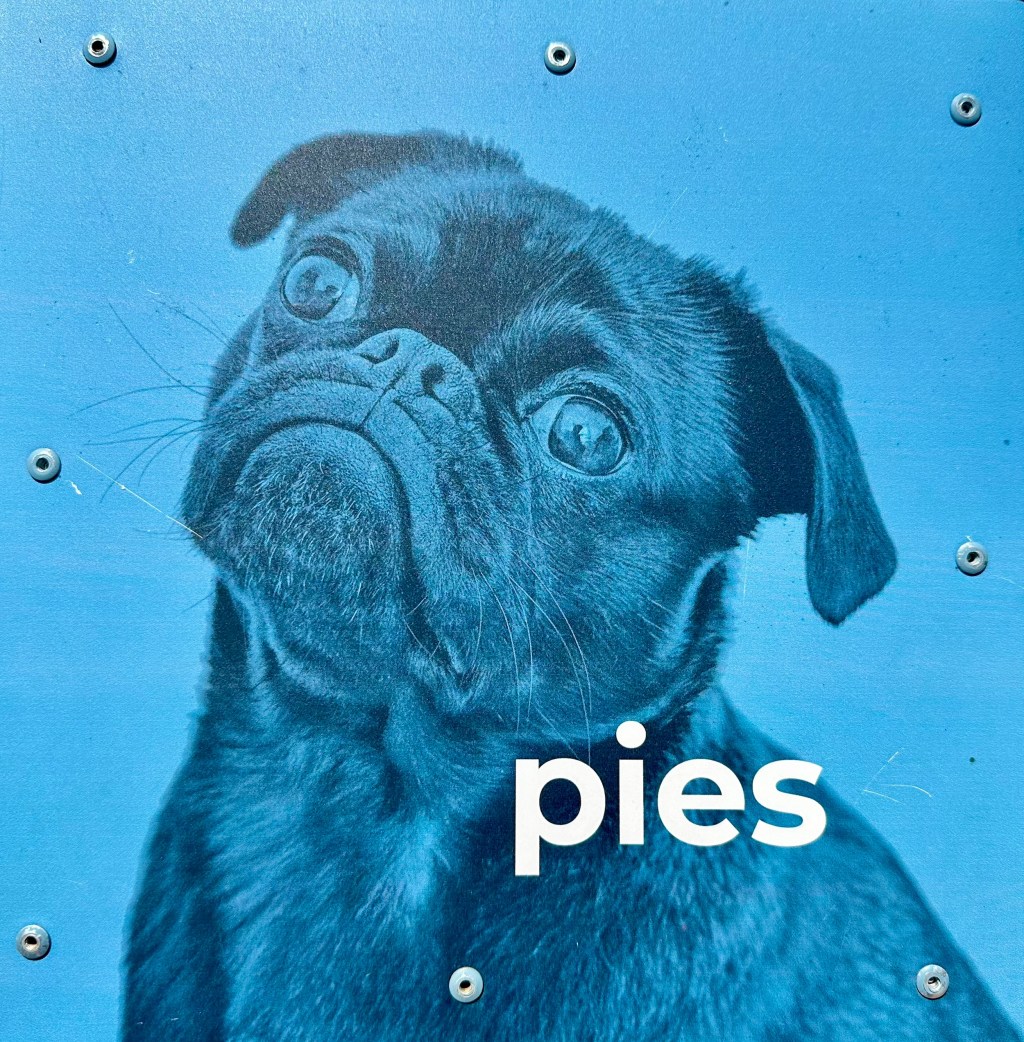
Dog in Polish is “pies” – easy, right? Not so fast! “Pies” is the basic form, but the form changes depending on the context. Let’s look at a few examples in three great songs.
Jump straight to:
- “Pies” by Ralph Kaminski
- “Psy” by Kaliber 44
- “Autoportret z psem” by Jacek Kaczmarksi
- Summary of dog words used in these songs
1. “Pies” by Ralph Kaminski
Cute as pie(s), this track is taken from Ralph’s 2022 album Bal u Rafała.
The lyrics are perfect for students of Polish – short simple sentences and a several useful words and phrases:
| Polish | English | Comment |
| Jestem gotów na drogę, nową drogę | I’m ready for the road, a new road | “Gotów” is the masculine form. If you’re a lady, you’ll say “Jestem gotowa”. |
| Z tobą, z tobą, z tobą | With you, with you, with you | See this post for more about “z tobą”! |
| Jestem gotów, by dzielić, dzielić życie | I’m ready to share, share life | |
| I siebie dzielić z tobą | And share myself with you | |
| To nie tydzień, a lata, czas mi lata | It’s not a week, but years, time flies | literally “time flies from me” |
| I mało co pociesza mówią mi, mówię sobie | And there’s little comfort they say, I tell myself | |
| Że warto, warto czekać | That it’s worth it, worth the wait | |
| I patrzę się w okno jak Reksiu i Dolly | And I stare out the window like Reksiu and Dolly. | “Reksiu” is a reference to the classic Polish cartoon about a dog. I’m not sure what “Dolly” refers to. |
| Gdy wypatrują mnie | When they’re watching me | |
| I smucę się smutkiem jak oni | And I’m sad with sadness like them | |
| Bo długo nie ma mnie | Because I’ve been gone for so long | |
| Przytul, przytul, przytul mnie | Hug, hug, hug me | |
| Smutny jestem tak jak pies | I’m sad like a dog | |
| Nakarm, nakarm, nakarm mnie | Feed, feed, feed me | |
Głodny jestem tak jak pies | I’m hungry like a dog | A more common expression is “głodny jak wilk” (hungry like a wolf). Also “głodny” is the masculine form – girls say “Głodna jestem”. |
| Hau hau hau hau hau hau hau hau | Woof woof woof woof woof woof woof woof |
Who’s Ralph Kaminski?
Ralph Kaminski blends alternative pop and cinematic soundscapes into something uniquely his own.
I recommend his debut album Morze from 2016 and his interpretations of Maanam songs on the album called Kora from 2021 (named after the lead singer of Maanam).
Also check out his version of Modern Talking’s Cheri cheri lady, released together with Smolik in 2024.
2. “Psy” by Kaliber 44
A classic track from the second album by the (self-proclaimed) psycho-rappers Kaliber 44.
“Psy” (“dogs” in the basic/nominative plural form) is a bit like an almost 5-minute-long tongue-twister. As a non-Polish speaker, it’s fascinating to hear Joka & co jumping from one consonant cluster to the next – within 2 lines, there’s szczeka, uciekam, przyrzekam and czekam 😅
Not for the fainthearted! Best to simply fish out a few interesting words and phrases to practice:
| Polish | English | Comment |
| nie kupuję psa | I’m not buying a dog | “Psa” is genitive, the grammatical form needed when “dog” is the object in a negative sentence 🫠 |
| który na mnie szczeka | that’s barking at me | |
| nie uciekam | I’m not running away | |
| przyrzekam | I swear | In the sense “I promise”, not in the sense “I curse” / “I use offensive language” |
| czekam | I’m waiting | You might hear people say “poczekam” instead of “czekam”. Adding “po” implies that the waiting is expected to come to and end in the foreseeable future. “Czekam” refers more to ongoing or repeated actions. |
| jestem pewien | I’m sure | “Pewien” is the masculine form. As a woman, you’d say “Jestem pewna“. |
About Kaliber 44
Learn more about Kaliber 44 in this post.
3. “Autoportret z psem” by Jacek Kaczmarski
“Autoportret z psem” (“Self-portrait with a dog”) is a brilliant example of the more humorous side of the singer/songwriter Jacek Kaczmarski.
Uwaga! The lyrics are not easy for learners of Polish. But we can always dig out some words and phrases to practise!
A few easy words and phrases for learners of Polish
| Polish | English | Comment |
| Mój pies nie lubi psów | My dog doesn’t like dogs | As you can see, “dogs” is “psów”, not “psy” as in the track by Kaliber 44. “Psów” is the plural version when it’s the object in a negative sentence 🫠 |
| A ja nie lubię ludzi | And I don’t like people | Note that “and” is usually “i”. “A” is only used in sentences that show contrast – in this case, the dog and his owner dislike two different things (dogs and people) |
| Upewnić się | To make sure | The literal meaning is “to make oneself sure”, where the little word “się” signals “oneself” |
| Ja miałem już dwie żony | I’ve already had two wives | Note that the word “Ja” (“I”) is not usually needed, as Polish verbs – “miałem”, in this case – have endings that reveal who we’re talking about. “Miałem” means “I’ve had” on its own. The same goes for similar words like “ty” (“you”), “on” (“he”), “ona” (“she”) and so on. But they can be used for emphasis or if needed for clarity. |
| Ogon | Tail | |
| Nos | Nose | |
| Radość | Joy | |
| Piękny | Beautiful |
Intro to Jacek Kaczmarski
Jacek Kaczmarski (1957–2004) was one of Poland’s most iconic protest singers.
Many of his songs, and especially the epic “Mury”, became the soundtrack of the Polish Solidarność movement, which played a crucial part in the dismantling of the communist regime. He’s even known as the “Bard of Solidarność”.
Jacek died from cancer in 2004 at the age of 47 😢
4. Summary of dog words used in these songs
Uwaga! This is by no means a complete account of the word “dog” in Polish. One thing I’ve learnt over the years is that with Polish, there’s always more to learn!
See it as an introduction to some of the most common words for dog:
| Polish word for dog | Comment |
| Pies 🐶 | The basic (nominative) word for dog |
| Psy 🐶🐶 | The basic (nominative) word for dogs |
| Psa 🐶 | The word for dog in the genitive case, which includes negative sentences where “dog” is the object |
| Psem 🐶 | The word for dog in sentences with “z” (with). In grammar speak, it’s the instrumental case |
| Psów 🐶🐶 | The word for dogs in the genitive case, which includes negative sentece where “dog” is the object |


Leave a comment